OP-1 User Guide: A Comprehensive Overview (Updated 04/30/2026)
Welcome! This manual, version 1.2, details the OP-1’s features, updated for the current OS. Explore, experiment, and visit op-forums.com for pro tips!
The OP-1 is a remarkably intuitive portable synthesizer, sampler, and sequencer, designed for musical exploration and creative expression. While its interface encourages immediate play, this guide unlocks a deeper understanding of its functions and modes. Don’t hesitate to experiment – the OP-1 thrives on discovery!
This manual, now updated to version 1.2, covers all aspects of the OP-1, ensuring you get the most from your instrument. Before connecting external devices, power them off to prevent potential malfunctions or damage; Remember to connect cables to the OP-1 first. Embrace the shake-to-clear function for a fresh start, or use the blue encoder for selective erasure.
What’s in the Box?
Upon opening your OP-1 package, you should find the portable synthesizer itself, a testament to innovative musical design. Crucially, included is the OP-1 Operators Manual, Version 1.2 – your comprehensive guide to unlocking the instrument’s full potential. This manual is fully updated to reflect the current operating system and all features.
Carefully reading this manual is highly recommended to maximize your OP-1 experience. For even deeper insights and community-driven tips, explore the resources available at op-forums.com. Remember the safety precaution: always power down connected devices before establishing connections to avoid potential issues.
Initial Setup and Powering On
Before connecting the OP-1 to any external devices, a crucial safety step is to ensure all connected units are powered off. This preventative measure minimizes the risk of malfunctions or potential damage to speakers and other equipment. When connecting or disconnecting cables during operation, prioritize connecting the cable to the OP-1 field first.
The OP-1 is designed for intuitive use, but familiarizing yourself with the manual enhances understanding. Don’t hesitate to explore its functions and modes; the manual is always available as a reference. Remember, a simple shake erases your sketch, offering a fresh start!

Understanding the OP-1 Interface
Explore the core! The OP-1 features four tracks, intuitive encoders and buttons for control, and a display screen providing essential visual feedback.
The Four Tracks: A Core Concept
Central to the OP-1’s workflow are its four independent tracks. These tracks function as the building blocks for your musical creations, allowing for layering and arrangement of diverse sounds. Each track can host either a synthesizer, drum machine, or a sampled audio clip.
Think of them as individual lanes within a recording studio. You can record directly onto a track using the built-in microphone or line input, or sequence patterns using the various sequencer modes. The ability to independently control each track’s volume, pan, and effects is crucial for crafting a balanced and dynamic mix. Mastering these tracks unlocks the full potential of the OP-1.
Encoders and Buttons: Navigation and Control
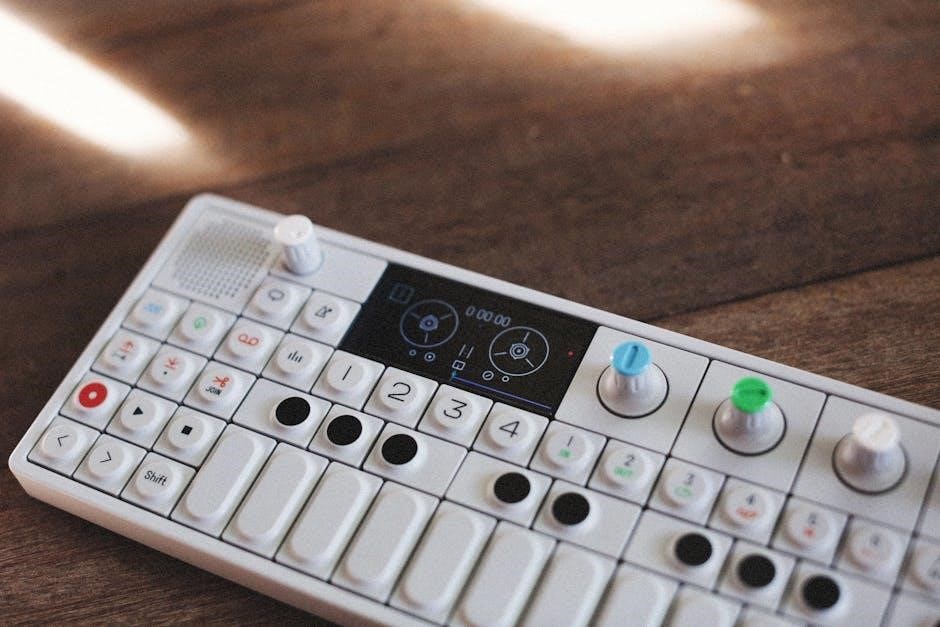
The OP-1’s interface revolves around a combination of encoders (rotary knobs) and buttons, providing tactile control over its numerous functions. Encoders are your primary means of adjusting parameters like volume, filter cutoff, and envelope settings. Buttons, often used in conjunction with the shift key, access deeper menu options and trigger specific actions.
Understanding the encoder and button layout is key to efficient operation. The colored encoders typically control parameters relevant to the currently selected mode. Experiment with holding ‘shift’ while turning encoders to discover hidden functionalities. Intuitive navigation is a core design principle of the OP-1.
The Display Screen: Visual Feedback
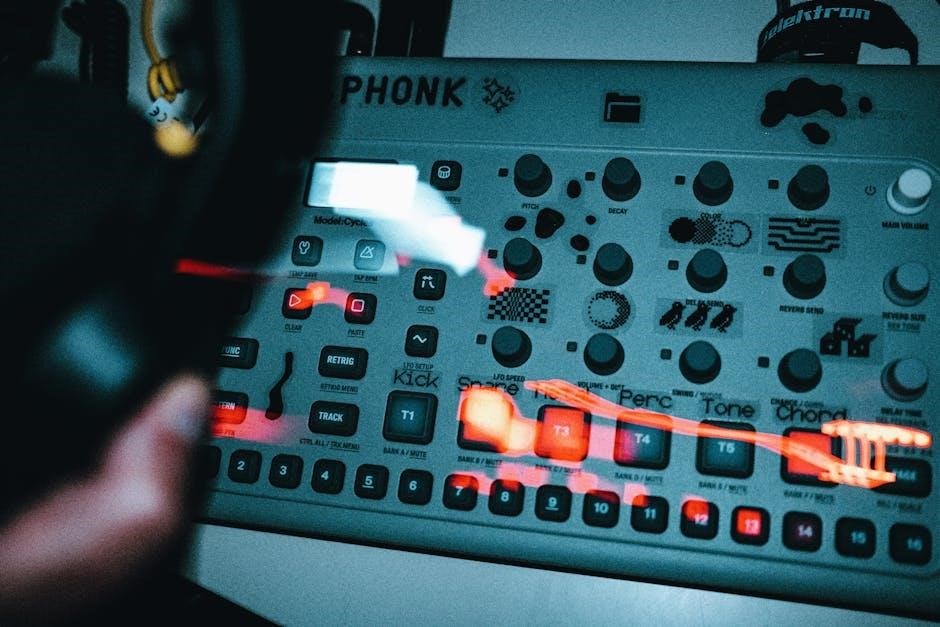
The OP-1’s display screen serves as your central hub for visual information, providing crucial feedback on your actions and the instrument’s state. It dynamically changes to reflect the selected mode – Tape, Synth, Drum, or Sequencer – displaying waveforms, sequencer patterns, and parameter values.
Pay close attention to the screen’s indicators, as they offer insights into levels, recording status, and active effects. While relatively small, the display is remarkably informative. Mastering the visual cues presented on the screen will significantly enhance your workflow and understanding of the OP-1’s capabilities.

Tape Mode: The Heart of the OP-1
Tape Mode is central to the OP-1 experience, enabling recording, playback, and manipulation of sounds. It’s where your musical ideas truly come to life!
Recording and Playback Basics
Getting started with Tape Mode is straightforward. Press the red REC button to begin capturing audio from any input source – synthesizer, drum machine, or external instruments. The OP-1 records directly onto the “tape,” visualized on the display screen. Playback is initiated by pressing the PLAY button. You can fast forward (FF) and rewind (RW) using the corresponding buttons, just like a traditional tape recorder.
Crucially, the OP-1’s tape is non-destructive. This means your original recordings are preserved, allowing for endless experimentation and layering. Use the transport controls to navigate the tape and find the perfect starting point for your next musical adventure. Remember to save your work frequently!
Tape Manipulation: Punch-In Recording
Punch-in recording allows for precise edits to your existing tape sketches without re-recording the entire track. To initiate, position the tape head to the desired edit point using the transport controls. Then, hold SHIFT and press REC. This activates punch-in mode, recording over the existing audio from that point forward.
Mastering this technique unlocks creative possibilities for fixing mistakes, adding variations, or layering new elements onto your compositions. Release SHIFT to stop recording and seamlessly integrate your punch-in. Experiment with different punch-in points to sculpt your sound!
Tape Effects: Adding Character and Depth
The OP-1’s tape effects are central to its unique sonic signature, offering a range of textures to enrich your recordings. These effects, accessible via the tape head controls, include wow & flutter, saturation, and compression – all modeled after classic tape machines.
Experimenting with these effects can dramatically alter the character of your sounds, adding warmth, grit, or subtle movement. Utilize the effect depth encoder to fine-tune the intensity, and explore combinations for truly distinctive results. Don’t be afraid to push the limits and discover new sonic landscapes!
Erasing Sketches: The Shake-to-Clear Function
The OP-1 features a delightfully unconventional method for clearing your current sketch: simply pick up the unit and physically shake it! This instantly erases everything, providing a clean slate for new musical ideas. It’s a quick and intuitive way to start fresh, encouraging spontaneous creativity.
Alternatively, you can hold the shift key and rotate the blue encoder counter-clockwise to manually erase the sketch backwards. This offers more controlled erasure, allowing you to selectively remove sections. Both methods are readily available, catering to different workflows and preferences.
Synthesizer Mode: Sound Design
Dive into sound creation! Explore oscillator selection, waveforms, filter control, and envelope shaping (ADSR) to craft unique tones within the OP-1’s synthesizer mode.
Oscillator Selection and Waveforms
Unlocking Sonic Possibilities: The OP-1’s synthesizer mode boasts a diverse range of oscillators, each offering a unique tonal character. Experiment with different waveforms – sine, square, sawtooth, triangle, and noise – to establish the fundamental building block of your sound. Each oscillator provides a distinct harmonic content, influencing the overall timbre.
Explore the pulse width modulation (PWM) capabilities for dynamic texture changes. Further refine your sound by utilizing multiple oscillators simultaneously, layering waveforms for complex sonic palettes. The OP-1 allows for precise control over oscillator pitch and detuning, enabling rich and evolving sounds. Mastering oscillator selection is key to unlocking the full potential of the OP-1’s synthesis engine.
Filter Control and Modulation
Sculpting Your Sound: The OP-1’s filter section is crucial for shaping the tonal characteristics of your synthesized sounds. Control the cutoff frequency to attenuate high frequencies, creating warmer or darker tones. Adjust the resonance to emphasize frequencies around the cutoff point, adding character and expressiveness.
Explore filter modulation options using LFOs or envelopes to create dynamic and evolving filter sweeps. This adds movement and interest to your sounds. Experiment with different filter types for varied sonic results. Mastering filter control allows you to sculpt your sounds with precision and create unique textures within the OP-1’s synthesis environment.
Envelope Shaping: Attack, Decay, Sustain, Release
Dynamic Control: The ADSR envelope is fundamental to sound design on the OP-1. Attack determines how quickly a sound reaches its peak volume. Decay controls the time it takes for the sound to fall from the peak to the sustain level. Sustain defines the volume level held while a key is pressed. Finally, Release dictates how long the sound takes to fade after the key is released.
Experimenting with these parameters dramatically alters a sound’s character. Short attacks create percussive sounds, while long attacks build slowly. Adjusting decay and release shapes the overall feel and expressiveness of your synthesized tones.
Drum Mode: Rhythmic Foundation
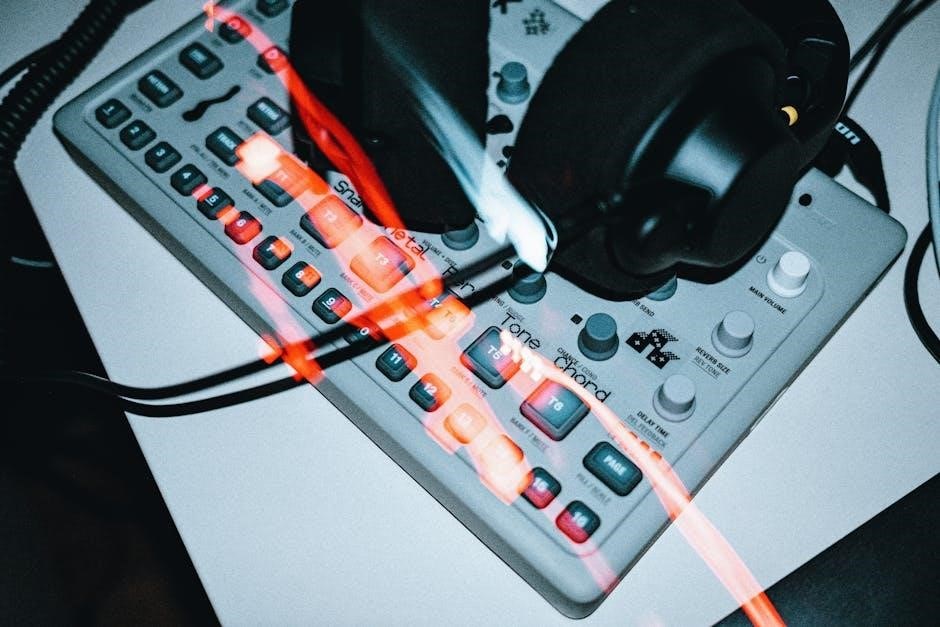
Beat Creation: Drum mode offers dedicated sequencer memory and kit editing. Craft unique rhythms and patterns, utilizing effects to enhance your percussive soundscapes.
Drum Kit Selection and Editing
Diverse Sounds: The OP-1 boasts a variety of pre-loaded drum kits, offering a broad sonic palette for your rhythmic explorations. Easily cycle through these kits to find the perfect foundation for your track.
Customization is Key: Beyond the presets, the OP-1 empowers you to deeply edit each drum kit. Individually tweak the sounds of each drum – kick, snare, hi-hat, and more – to sculpt a truly personalized percussive experience. Adjust parameters like pitch, decay, and volume to achieve the desired impact.
Sound Design: Experiment with layering sounds and utilizing the OP-1’s effects to further refine your drum kit. Create unique textures and rhythms that set your music apart. The possibilities are truly endless!
Sequencing Drum Patterns
Rhythmic Foundation: Once you’ve selected or crafted your ideal drum kit, the OP-1’s sequencer allows you to bring your rhythms to life. Utilize the various sequencer modes – Unlimited, Pattern, Step, and Coordinate – to arrange your drum patterns in diverse and creative ways.
Intuitive Control: The OP-1’s interface provides a hands-on experience for sequencing. Easily input notes, adjust timing, and experiment with different rhythmic variations. Each sequencer mode offers a unique approach to pattern creation, catering to different workflows.
Layered Complexity: Build intricate and dynamic drum patterns by layering multiple sequences and utilizing the OP-1’s powerful editing tools. Explore polyrhythms and syncopation to add depth and groove to your music.
Adding Effects to Drums
Sonic Enhancement: The OP-1’s tape effects aren’t limited to melodic tracks; they dramatically enhance drum sounds too! Apply reverb, delay, and other effects to add character, depth, and a unique sonic signature to your drum patterns.
Creative Processing: Experiment with different effect combinations to sculpt your drum sounds. From subtle ambience to extreme distortion, the OP-1 offers a wide palette of sonic possibilities. Utilize the tape manipulation features for further creative control.
Dynamic Textures: Introduce movement and interest by automating effect parameters over time. This adds dynamic textures and evolving soundscapes to your drum tracks, elevating your rhythmic foundation.
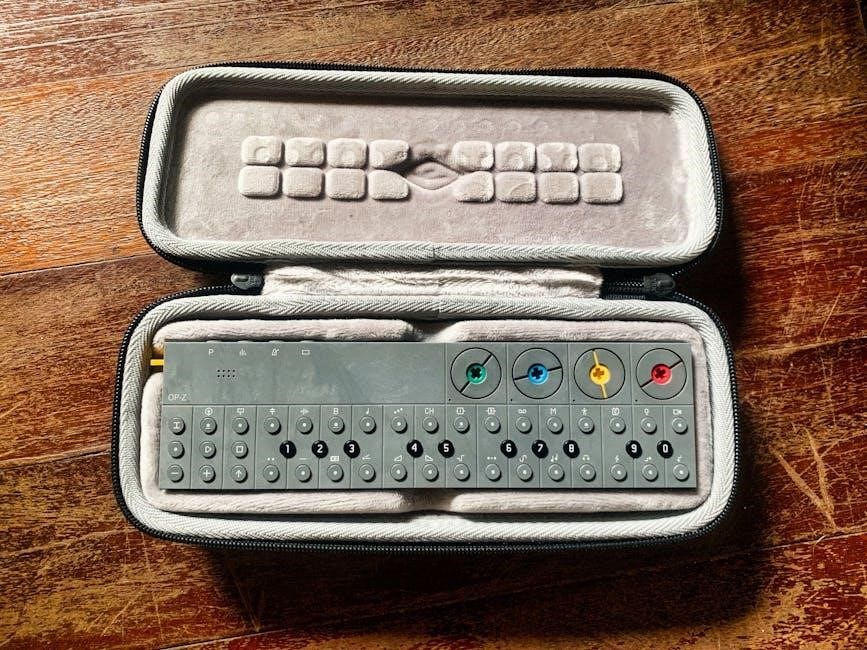
Sequencer Modes: Arranging Your Music
Arrangement Tools: The OP-1 boasts four unique sequencers—Unlimited, Pattern, Step, and Coordinate—offering flexible note arrangement and diverse rhythmic possibilities.
Unlimited Sequencer: Flexible Note Arrangement
Unleash Creativity: The Unlimited Sequencer provides unparalleled freedom in arranging notes, allowing for dynamic and evolving musical ideas. Unlike other sequencers, it doesn’t loop in a traditional sense, offering a continuous timeline for composition. This mode excels at building complex arrangements where repetition isn’t the primary goal.
You can input notes directly using the keyboard or via external MIDI control. The sequencer records everything you play, creating a flowing sequence that can be edited and manipulated in real-time. Experiment with varying note lengths, velocities, and positions to craft intricate and captivating musical passages. It’s perfect for creating evolving soundscapes and unpredictable melodies.
Pattern Sequencer: Looping and Repetition
Rhythmic Foundation: The Pattern Sequencer is ideal for creating repeating musical phrases and building rhythmic structures. It operates on a loop-based system, allowing you to define a specific number of steps that will repeat continuously. This makes it perfect for crafting driving basslines, hypnotic melodies, and intricate drum patterns.
Input notes into each step of the pattern, adjusting their timing and velocity to create variations. Experiment with different pattern lengths and step resolutions to achieve diverse rhythmic effects. The Pattern Sequencer’s simplicity and directness make it a powerful tool for quickly establishing a solid groove and building the foundation of your track.
Step Sequencer: Precise Control
Detailed Composition: The Step Sequencer offers a highly granular approach to sequencing, providing precise control over each individual note or event. Unlike the Pattern Sequencer’s looping structure, the Step Sequencer allows for non-repeating sequences and complex rhythmic arrangements. This is achieved by manually entering steps and defining their timing, pitch, and velocity.
Each step can be individually edited, enabling intricate patterns and dynamic variations. Utilize the Step Sequencer for crafting detailed melodies, complex drum fills, or evolving soundscapes. Its precision makes it ideal for situations where timing and note placement are critical to the musical outcome.
Coordinate Sequencer: Unique Pattern Creation
Grid-Based Sequencing: The Coordinate Sequencer presents a unique approach to pattern creation, utilizing a grid-based interface. This allows users to define notes not just by timing, but also by their position within the grid, opening up possibilities for unconventional rhythms and melodic structures. It’s a departure from traditional linear sequencing methods.
Experiment with different grid resolutions and step densities to generate complex and evolving patterns. The Coordinate Sequencer excels at creating unpredictable and organic sequences, perfect for adding a touch of randomness and experimentation to your music. It’s a powerful tool for sonic exploration.
Sampling: Capturing and Manipulating Audio
Capture Sounds: The OP-1 excels at sampling! Record audio from various sources, then edit, time-stretch, and pitch-shift to create unique textures and loops.
Sampling Sources and Techniques
Diverse Inputs: The OP-1 readily samples from a multitude of sources. Utilize its built-in microphone for ambient recordings, or connect external audio via the line-in jack. You can even sample directly from other instruments or even your computer!
Recording Process: Initiate sampling in Tape Mode. Select a tape head, then press record while providing the audio source. Experiment with different input levels to achieve optimal signal strength without clipping. Remember to monitor the audio levels on the display screen.
Creative Approaches: Don’t limit yourself to conventional sources! Explore field recordings, vocal snippets, or even the sounds of everyday objects. The OP-1’s sampling capabilities encourage experimentation and sonic discovery.
Editing Samples: Time Stretching and Pitch Shifting
Manipulating Time: Once sampled, the OP-1 allows for extensive editing. Time stretching alters the sample’s duration without affecting its pitch, creating slowed-down or sped-up effects. This is achieved through the tape manipulation controls, offering granular control over playback speed.
Pitch Control: Pitch shifting changes the sample’s tonal height. Experiment with raising or lowering the pitch to create unique textures and harmonies. Combine time stretching and pitch shifting for complex sonic transformations.
Creative Potential: These tools unlock a world of creative possibilities, allowing you to reshape and reimagine your samples into entirely new sounds.
Using Samples in Tracks
Integration is Key: Samples seamlessly integrate into the OP-1’s four tracks. Assign a sample to any track – synthesizer, drum, or tape – to build layered compositions. The OP-1 treats samples as audio sources, allowing manipulation like any other sound.
Layering and Effects: Combine samples with synthesized sounds and drum patterns for rich textures. Utilize the tape effects to further process and sculpt your sampled audio within the track environment.
Creative Workflow: Samples become building blocks, fostering a dynamic and versatile workflow for music creation on the OP-1.
Connectivity and External Devices
Expand Your Setup: Connect to audio interfaces, MIDI devices, and computers via USB. Power off all units before connecting to prevent damage!
Audio Input and Output
Versatile Connections: The OP-1 offers flexible audio capabilities. Utilize the built-in microphone for immediate sampling, or connect external audio sources via the input jack for expanded sonic possibilities. For output, connect to headphones for private practice, or link to speakers and recording interfaces for sharing your creations and further processing.
Signal Flow: Remember to power down all connected devices before establishing connections to safeguard against potential malfunctions or damage to sensitive equipment like speakers. Always connect cables to the OP-1 field first, ensuring a stable and secure connection. This practice minimizes the risk of unwanted noise or signal interruptions during operation.
MIDI Integration
Expand Your Setup: The OP-1 seamlessly integrates with other MIDI-compatible devices, unlocking a world of creative possibilities. Control the OP-1 from external keyboards, drum pads, or control surfaces, or use the OP-1 to control other synthesizers and software instruments.
Versatile Control: MIDI allows for precise control over various OP-1 parameters, including note data, velocity, and control change messages. This opens up opportunities for complex arrangements and dynamic performances. Explore different MIDI configurations to tailor the OP-1’s response to your specific workflow and musical needs, enhancing your creative process.
USB Connectivity and Data Transfer
Seamless Connection: The OP-1 utilizes USB connectivity for a variety of functions, including data transfer and potential power. Connect to your computer to back up your sketches, share creations with others, or update the OP-1’s operating system to the latest version.
Sketch Management: USB connectivity facilitates easy sketch management. Transfer sketches to your computer for archiving, editing in other software, or collaboration. Ensure all devices are powered off before connecting/disconnecting to prevent malfunctions or damage. This ensures a smooth and reliable data exchange process.
Troubleshooting and Common Issues
Need Help? This section addresses audio problems, sequencing errors, and deciphering error messages. Power cycling often resolves unexpected behavior!
Addressing Audio Problems
No Sound? First, verify the volume knob isn’t muted and check the output routing. Ensure headphones are properly connected, or external speakers are powered on and selected. If using external devices, confirm all cables are securely fastened – connect to the OP-1 field first!
Distorted Sound? Lower the master volume or individual track levels. Excessive gain staging can cause clipping. Experiment with filter settings and effects to refine the audio signal. Check for conflicting MIDI signals if using external controllers.
Unexpected Noise? Try a different audio cable. Ground loops can introduce hum; ensure proper grounding of all connected equipment. A system reset might resolve intermittent audio glitches.
Resolving Sequencing Errors
Stuck Notes? If notes hang unexpectedly, check for stuck keys or MIDI loops. Clear the sequencer memory for the affected track and reload the pattern. Ensure proper timing resolution settings within the sequencer mode.
Pattern Not Playing? Verify the sequencer is active and the playhead is moving. Confirm the pattern length is correctly set and that notes are within the defined range. Check for accidental muting of the track.
Synchronization Issues? When using multiple sequencers, ensure they are properly synchronized. Adjust tempo settings and experiment with swing/shuffle parameters to achieve desired rhythmic alignment.
Understanding Error Messages
“Disk Full” Error: This indicates insufficient storage for saving or sampling. Delete unused sketches, samples, or data via USB transfer to free up space. Regularly back up your work to prevent data loss.
“File Corrupted” Error: A saved file may be damaged. Attempt to reload an older backup if available. Avoid abruptly powering off the OP-1 during save operations to minimize corruption risks.
“MIDI Error” Error: Indicates a problem with MIDI communication. Check MIDI cable connections, device settings, and ensure compatibility between devices. Restart both the OP-1 and the connected MIDI device.
Leave a Reply
You must be logged in to post a comment.