
EQ Level Guide: A Comprehensive Overview (Updated 03/06/2026)
Emotional Quotient (EQ), or emotional intelligence, signifies a person’s ability to understand and manage their own emotions,
and recognize emotions in others. It’s crucial for self-management and interpersonal skills.

What is EQ? Defining Emotional Quotient
Emotional Quotient (EQ), often described as emotional intelligence or the “wisdom of emotions,” represents a person’s capacity to recognize, understand, and effectively manage their own emotions, as well as perceive and influence the emotions of others. Unlike traditional measures of intelligence, such as IQ, which focus on cognitive abilities like reasoning and problem-solving, EQ delves into the realm of feelings and interpersonal dynamics.
Essentially, EQ is a measure of how well an individual navigates the emotional landscape of life. It encompasses self-awareness – understanding one’s own emotional states – self-regulation – managing impulses and moods – motivation – driving oneself towards goals – empathy – recognizing emotions in others – and social skills – building and maintaining relationships.
The concept of EQ gained prominence through the work of psychologists like Peter Salovey and John Mayer, who proposed a framework for understanding emotional intelligence. Their research highlighted the importance of emotional abilities in various aspects of life, from personal well-being to professional success. EQ isn’t simply about “being nice”; it’s about possessing a sophisticated understanding of emotions and utilizing that understanding to make informed decisions and build strong connections.
The Significance of EQ in Human Capabilities
Emotional Quotient (EQ) profoundly impacts a wide spectrum of human capabilities, extending far beyond interpersonal relationships; While often associated with social adeptness, a high EQ correlates strongly with success in leadership, teamwork, and even individual performance across diverse fields. Individuals with well-developed EQ demonstrate enhanced self-awareness, enabling them to recognize their strengths and weaknesses, and adapt their behavior accordingly.
This self-understanding fosters greater resilience in the face of adversity, allowing for effective stress management and quicker recovery from setbacks. EQ also plays a crucial role in decision-making, as it allows individuals to consider the emotional implications of their choices, leading to more thoughtful and balanced outcomes.
Furthermore, EQ is vital for building trust and rapport, essential components of effective communication and collaboration. In professional settings, leaders with high EQ inspire and motivate their teams, fostering a positive and productive work environment. Ultimately, EQ isn’t merely a “soft skill”; it’s a fundamental capability that underpins success in nearly every facet of human endeavor, influencing both personal fulfillment and professional achievement.
EQ vs. IQ: Understanding the Differences
Intelligence Quotient (IQ) and Emotional Quotient (EQ) represent distinct facets of cognitive ability, though both contribute to overall success. IQ traditionally measures logical reasoning, mathematical ability, and linguistic skills – abilities often assessed through standardized tests. It reflects a person’s capacity for learning and problem-solving in a structured environment.
However, IQ doesn’t fully account for how individuals navigate the complexities of human interaction or manage their emotional responses. This is where EQ comes into play. EQ, or emotional intelligence, encompasses self-awareness, self-regulation, empathy, and social skills. It’s the ability to perceive, understand, manage, and utilize emotions effectively.
While IQ remains relatively stable throughout life, EQ can be developed and improved with conscious effort. Research suggests that EQ is a stronger predictor of performance in roles requiring significant interpersonal skills and leadership. Essentially, IQ helps you know what to do, while EQ helps you know how to do it – and how to effectively interact with others while doing so. Both are valuable, but EQ often proves crucial for navigating life’s challenges.

The Four Dimensions of EQ Assessment (Based on Mayer & Salovey)
John Mayer and Peter Salovey’s model outlines four key dimensions for assessing Emotional Quotient (EQ). The first is Perceiving Emotions – the ability to accurately identify emotions in oneself and others, through facial expressions, body language, and other cues. This forms the foundation of emotional intelligence.
Next is Using Emotions to Facilitate Thought, where emotions are leveraged to enhance cognitive processes like problem-solving and creativity. Emotions aren’t seen as disruptive, but as valuable sources of information.
The third dimension, Understanding Emotions, involves comprehending the complexities of emotions – their causes, consequences, and relationships. This includes recognizing emotional blends and transitions.
Finally, Managing Emotions refers to the capacity to regulate one’s own emotions and influence those of others. This doesn’t mean suppressing emotions, but rather handling them constructively. Assessments like the EIS (Emotional Intelligence Scale) often reference these four dimensions, providing a comprehensive evaluation of an individual’s emotional capabilities.

EQ and Self-Management: Controlling Your Emotions
Self-management, a core component of Emotional Quotient (EQ), centers on the ability to effectively regulate one’s emotions. This isn’t about suppressing feelings, but rather understanding and responding to them in a healthy and constructive manner. Individuals with high EQ demonstrate resilience, adapting well to stress and setbacks.
Effective self-management involves recognizing emotional triggers – the situations or thoughts that evoke strong emotional responses. Once identified, strategies can be employed to manage these reactions, such as deep breathing exercises, mindfulness techniques, or reframing negative thoughts.

Furthermore, self-awareness is crucial. Knowing your emotional strengths and weaknesses allows for targeted improvement. Impulse control is also key; high EQ individuals can resist acting on immediate emotional urges, considering long-term consequences.
Ultimately, mastering self-management isn’t about eliminating negative emotions, but about navigating them skillfully, maintaining composure, and making rational decisions even under pressure. This contributes significantly to personal and professional success.
EQ and Social Awareness: Recognizing Emotions in Others
Social awareness, a vital facet of Emotional Quotient (EQ), involves the capacity to accurately perceive and understand the emotions of those around you. This extends beyond simply identifying basic feelings like happiness or sadness; it encompasses recognizing subtle cues in body language, facial expressions, and tone of voice.
Empathy plays a central role in social awareness. It’s the ability to step into another person’s shoes and experience the world from their perspective. This allows for a deeper understanding of their emotional state and motivations.
Developing social awareness requires active listening – truly focusing on what others are saying, both verbally and nonverbally. It also involves being attuned to social dynamics and understanding unspoken rules.
Individuals with high social awareness are adept at building rapport, navigating complex social situations, and fostering strong relationships. They can anticipate others’ reactions and respond with sensitivity and tact, leading to more effective communication and collaboration.
EQ in Programming and Mathematical Operations: EQ, NEG, LT, GE, LE
While seemingly disparate, the abbreviation “EQ” finds a distinct application within the realm of programming and mathematical operations. Here, “EQ” represents the fundamental comparison operator for “equals to,” signifying equality between two values or expressions. This is a core concept in conditional statements and logical evaluations;
Alongside “EQ,” several other operators are frequently employed: “NEG” (not equal to), “LT” (less than), “GE” (greater than or equal to), and “LE” (less than or equal to). These operators form the building blocks of comparative logic, enabling programs to make decisions based on relationships between data.
In programming languages, these operators are used to control program flow, filter data, and validate inputs. For example, an “IF” statement might use “EQ” to execute a block of code only when a specific condition is met.
Understanding these operators is crucial for anyone involved in software development, data analysis, or any field requiring logical reasoning and algorithmic thinking. They are foundational to creating functional and reliable systems.
EQ in Audio Engineering: Equalization Basics
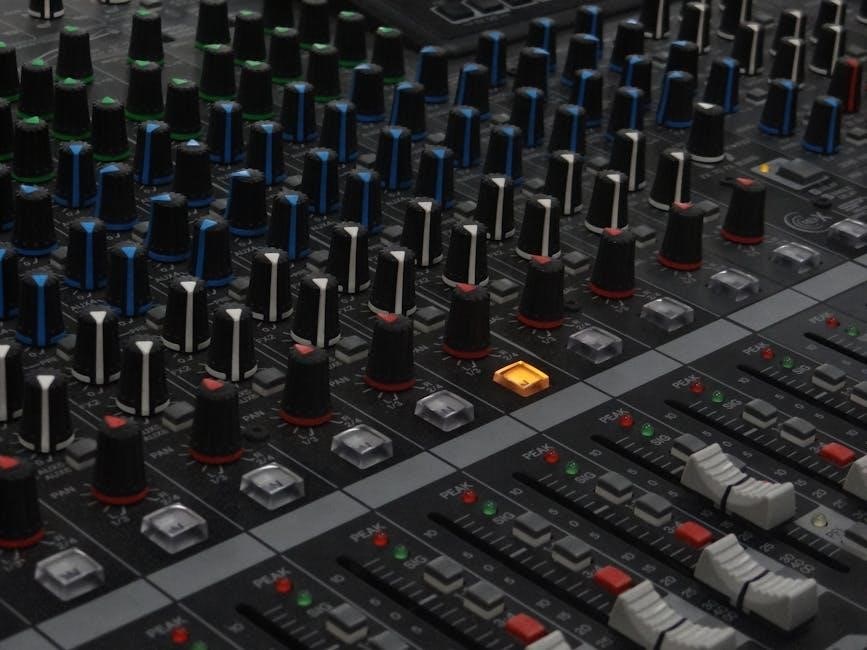
In audio engineering, EQ – short for equalization – is a powerful process used to manipulate the frequency content of audio signals. It’s essentially a toolkit for shaping the tonal balance of sound, allowing engineers to enhance clarity, correct deficiencies, and creatively sculpt the sonic landscape.

Equalization works by boosting or cutting the level of specific frequency ranges within an audio signal. This is achieved using filters that target different parts of the frequency spectrum, from the deep bass to the shimmering highs. The goal is to achieve a desired sound, whether it’s a polished mix or a specific artistic effect.
EQ is vital for compensating for imperfections in recordings, such as unwanted resonances or muddiness. It’s also used to create space for different instruments in a mix, ensuring that each element has its own sonic territory. Adjusting EQ impacts the mood and tension within a musical piece.
Mastering EQ involves subtle adjustments to enhance the overall sonic quality and ensure compatibility across various playback systems.
Frequency Ranges in Audio EQ: 20Hz ‒ 20kHz
The human ear typically perceives sounds within the range of 20Hz to 20kHz. This spectrum is broadly divided into distinct frequency bands, each contributing uniquely to the overall sonic experience. Understanding these ranges is fundamental to effective equalization.
Low Frequencies (20Hz ― 250Hz): This area contains the fundamental frequencies of bass instruments like kick drums and bass guitars, providing the foundational “weight” and “punch” of a mix. Excessive buildup here can cause muddiness.
Mid Frequencies (250Hz ‒ 4kHz): This is where most instruments reside, defining their core tonal character. The lower mids (250Hz-500Hz) contribute to warmth, while the upper mids (2kHz-4kHz) add clarity and presence.
High Frequencies (4kHz ― 20kHz): These frequencies add “air,” “sparkle,” and detail to a sound. They are crucial for instruments like cymbals and vocals, but can also introduce harshness if overemphasized.
Precise EQ adjustments within these ranges allow engineers to sculpt the tonal balance, enhancing clarity and creating a polished, professional sound.
EQ Controls: High, Mid, and Low Frequency Adjustment
Most equalizers (EQs) offer controls for adjusting high, mid, and low frequency bands. These controls allow precise shaping of the tonal balance of audio signals. Understanding their function is key to effective mixing and mastering.
Low-Frequency Controls: Typically boost or cut frequencies below 250Hz. Used to enhance bass response, remove muddiness, or tighten up low-end instruments like kick drums and bass guitars. Careful adjustment prevents unwanted rumble.
Mid-Frequency Controls: Operate between 250Hz and 4kHz. These controls shape the body and character of most instruments and vocals. Adjustments here impact clarity, warmth, and presence. Reducing harshness is a common application.
High-Frequency Controls: Affect frequencies above 4kHz. Used to add air, sparkle, and detail. Boosting can enhance cymbals and vocals, while cutting can reduce sibilance or harshness. Subtle adjustments are often best.
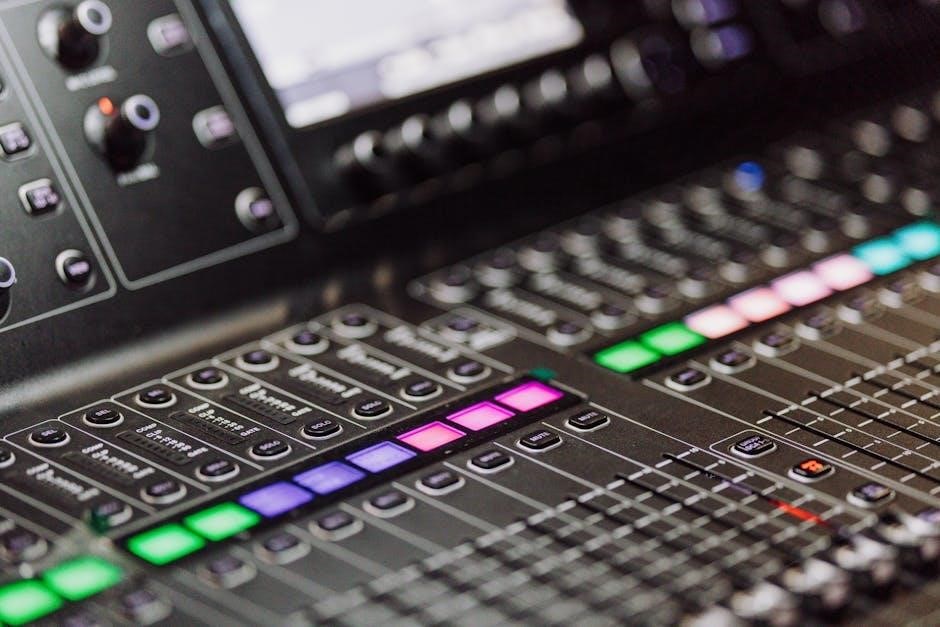
EQs often feature parametric controls (frequency, gain, Q) for detailed adjustments, alongside simpler shelving or peaking filters.
Using EQ to Influence Mood and Tension in Music
Equalization (EQ) is a powerful tool for shaping the emotional impact of music. Strategic frequency adjustments can dramatically alter the perceived mood and tension within a track. Understanding these effects is crucial for emotive mixing.
Boosting low frequencies can create a sense of power, weight, and even unease, particularly in genres like electronic or cinematic music. Conversely, reducing lows can create a lighter, more airy feel.
Mid-range adjustments significantly impact clarity and presence. A scooped mid-range can sound distant and ethereal, while a pronounced mid-range creates intimacy and focus. Harshness in the mids can induce tension.
High-frequency boosts add brightness and air, evoking feelings of joy or excitement. However, excessive highs can sound brittle or harsh, creating a sense of anxiety. Careful control is vital.
EQ can subtly build tension by gradually increasing specific frequencies, or release it by smoothing out harshness. It’s a nuanced art form.
EQ and Instrument Balancing in Mixes
Achieving a balanced mix isn’t solely about volume levels; Equalization (EQ) plays a pivotal role in ensuring each instrument occupies its own sonic space. It prevents muddiness and allows all elements to be clearly heard.
EQ helps carve out frequencies for each instrument. For example, reducing low-mid frequencies in a guitar track can prevent it from clashing with the bass. Conversely, boosting high frequencies in a vocal can help it cut through the mix.
Identifying frequency masking – where one instrument obscures another – is key. EQ can be used to attenuate frequencies in one instrument where another dominates, creating separation.
Subtractive EQ (cutting unwanted frequencies) is often more effective than additive EQ (boosting). It cleans up the mix and avoids harshness. Careful cuts create clarity.
EQ isn’t just corrective; it’s creative. Shaping the tonal balance of each instrument contributes to the overall sonic character of the mix, enhancing its emotional impact.
Common EQ Settings for Different Instruments (General Guidelines)
While no “one-size-fits-all” EQ setting exists, general guidelines can jumpstart your mixing process. Bass guitar typically benefits from a boost around 60-80Hz for fullness, and cuts around 250-350Hz to reduce muddiness.
Acoustic guitars often need a dip around 250Hz to tame boominess, and a gentle boost around 2-5kHz for clarity and presence. Electric guitars can benefit from a mid-range scoop (around 400-800Hz) for a modern sound, or a boost for warmth.
Vocals usually require a boost around 2-5kHz for intelligibility, and careful attention to sibilance (harsh ‘s’ sounds) which can be tamed with a narrow cut around 6-8kHz.
Drums often need low-end control (around 200-300Hz for kick, and 500-800Hz for snare). Cymbals benefit from high-frequency boosts (8kHz+) for shimmer, but be cautious of harshness.
Remember these are starting points. Always listen critically and adjust EQ settings based on the specific instrument, recording, and the overall mix context.
The Role of EQ in Compensating for Speaker and Room Defects
Speakers and listening environments invariably introduce coloration and imbalances into the audio signal. EQ can be a powerful tool to mitigate these issues, though it’s not a complete solution. Room acoustics often cause peaks and dips in certain frequencies due to reflections and resonances.
EQ can be used to gently reduce peaks that create harshness or muddiness, and subtly boost dips to restore balance. However, excessive EQ can introduce phase issues and worsen the problem. Speaker deficiencies, such as a lack of bass response or a harsh high-end, can also be addressed with EQ.
Careful measurement using room analysis software is recommended to identify specific problem areas. Parametric EQ offers precise control for targeting narrow frequency bands, while graphic EQ provides a broader, more visual approach.
It’s crucial to remember that EQ is a corrective tool, not a replacement for proper speaker placement and acoustic treatment. Addressing the root cause of the problem is always preferable.
Developing Your EQ: Techniques for Improvement
Enhancing your Emotional Quotient (EQ) is a continuous process requiring self-awareness and dedicated practice. Self-reflection is paramount; regularly assess your emotional responses to various situations, identifying triggers and patterns. Journaling can be a valuable tool for this.
Actively practice empathy by consciously attempting to understand others’ perspectives, even when you disagree. Seek feedback from trusted colleagues and friends regarding your interpersonal skills and emotional reactions. Be open to constructive criticism.
Mindfulness meditation can significantly improve emotional regulation and self-awareness. Cognitive Behavioral Therapy (CBT) techniques can help reframe negative thought patterns and develop healthier coping mechanisms.
Engage in active listening, paying full attention to both verbal and nonverbal cues. Consider taking an EQ assessment, like the EIS, to identify areas for improvement and track your progress. Remember, consistent effort yields substantial results.
Leave a Reply
You must be logged in to post a comment.